
Our Building and Archives
Our Location
We are located in an historic building complex on the edge of the Detroit Cultural Center and Wayne State University, in the heart of Detroit. We are also on the edge of the Cass Corridor, an area of deep poverty. As with many boundary zones, our location is rich with diversity.
In 2011, the church donated the complex of buildings, including the sanctuary and attached church house with social hall and second story church, to the East Michigan Environmental Action Council (EMEAC). We are now part of the EMEAC managed Cass Corridor Commons, a multi-use non-profit and green space in which educational activities, community efforts and business endeavors are created and carried out.
Our buildings are rich with history, beginning with the Perry McAdow House which was constructed in 1891. The mansion was sold to the First Unitarian-Universalist Church of Detroit in 1913, where we have worshiped ever since.
Stained Glass at the Church
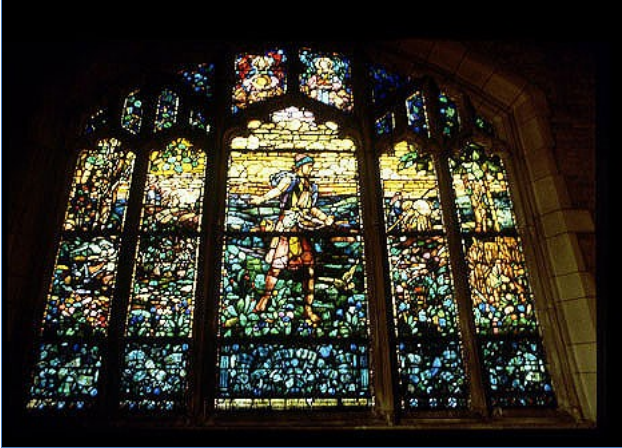
The Necomb Memorial Window: “The Sower”
The Newcomb Memorial Window was unveiled and dedicated on Sunday April 16, 1916. Quoting from the dedication folder that was handed out that day, “The Newcomb Memorial Window is from an original painting of THE SOWER, by William Willet and Annie Lee Willet, the artists who also made windows for the West Point Military Chapel and the dining hall of the Post-graduate College of Princeton. This window occupies the front gable of the beautiful building erected by Donaldson & Meier, and the predominant color tone is a golden glow which is made to vibrate with the rich bits of ruby, pink, green and purple of the oriental draperies and the flowers and leafage of the foreground, while the tracery openings are rich with the glorious Chartres blues for which these artists are noted.
The window is most successful in the play of color and light, and in the symbolic use of the figure as a decoration, and is made throughout of the costliest, imported, antique glasses, superimposed one upon the other, to secure depth of tone and is enriched with stains and acid work after the manner of Albrecht Durer and others of the ancient glass artists whose work has stood the test of centuries. As the dedication brochure boasts, “there is absolutely nothing in this window to fade or decay; hence it is a permanent expression of that form of art which is in itself a symbol of the Christian hope, tinged with the tints of the rainbow by the light of the ‘sun of heaven’ and in the dark night made visible and beautiful to the world by the light from within the church.”
It represents the “Parable of the Sower,” as told in the Bible’s Book of Luke. The central opening depicts the sower scattering seed, a symbol of the Word of God, across the field at sunrise. In three of the four side panels, some seed has fallen along the wayside and is being devoured by birds, while other seed has fallen on stony ground or among thorns where it will either wither or be choked. The panel at the far right pictures the golden wheat that will flourish on the fertile field, symbolizing the virtuous life. Angels of the sun and rain appear in the upper tracery openings. Inscribed below are the scriptural verse of the window’s theme and the names of Cyrenius Adelbert Newcomb and Mary Eliza Haskell Newcomb, in whose memory the window was dedicated.
Church Archives
In May of 2011 UU Detroit donated its buildings and property to the East Michigan Environmental Council with the agreement that the church may continue to worship in the sanctuary in perpetuity. Due to new space constrictions, we had to find a location to store our archives. An ad hoc team researched storage options and found the University of Michigan-Bentley Historical Library (BHL).
On March 18, 2013 a “Gift Agreement” was executed between First UU and the BHL. Subsequently 22 boxes of documents were donated to the library.
The BHL has the capacity to maintain the archives, the earliest of which go back to 1850, in a climate-controlled, contained and protected environment. The BHL has cataloged the archives and they are searchable electronically. We retain full access to the physical archives. Periodic additions to the records are expected. The archives may be found at: