
Our History
Early Unitarians and Universalists in Detroit
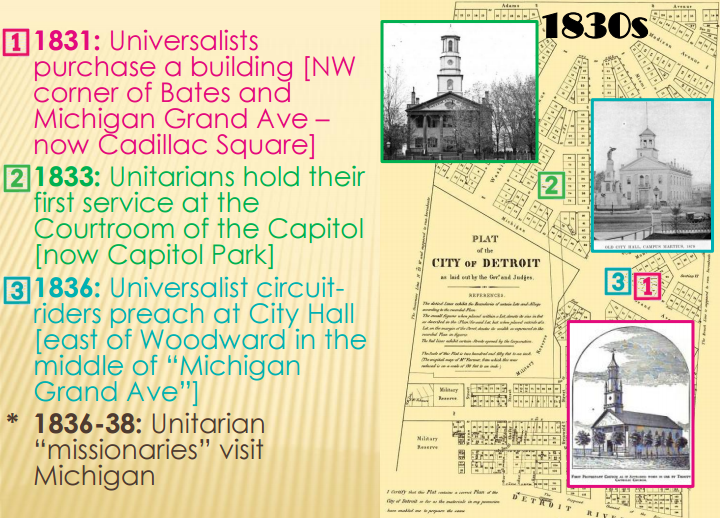
Our roots in Detroit go back over 180 years. Universalists first held a worship service in Detroit in 1831. The Unitarians weren’t far behind, in 1833. The two congregations met in several sites in the downtown Detroit area over the years.
In 1916, the Universalists moved to our present location at the corner of Cass and Forest. The church house was built by a lumber baron named McAdow in the late 1800s, and is a historic landmark. The architectural firm of Donaldson and Meier designed the sanctuary in the Neo-Gothic style. It has exposed timber trusses and beams, and the walls are trimmed with Indiana limestone.
Merger and Beyond
In 1932, the Unitarian Church lost one-third of its facade to the widening of Woodward Avenue. The loss of the facade made the building too small for the congregation. At the same time, the Universalist Church of Our Father lost its minister.
Since the two churches were religious liberals and had similar views on social justice for women, minorities, and the poor, it made sense for the two to join forces, at least temporarily. The two congregations voted to meet in the Universalist church building and hear sermons by the Unitarian minister for one year.
The temporary union of the two churches worked beyond everyone’s most optimistic hopes. In June 1934, both churches formally voted to merge. Nearly three decades later, in 1961 the two denominations merged on a national level.
Much like the city, yet in its own unique way, the congregation has had a long and varied history since the merger. Membership peaked at 600 in the late 1950s, but declined to 85 members by 2010.
Today, there are six suburban UU communities in the Detroit Tri-County Area: Beacon (Troy), Birmingham, Farmington, Grosse Pointe, New Hope (New Hudson), and Northwest (Southfield).
Read more about the history of UU Detroit in this pamphlet written by Ruth L. Braun. It is based on historical data that she and the late Arthur W. Birdsall compiled over a period of several years from many different sources.